Global Recognition
TSMU Georgia is accredited by the NCEQE and recognised by global medical bodies like ECFMG and WFME, and is listed in the WDOMS recognised by the WFME.
MBBS in Georgia · Tbilisi, Georgia
MBBS at Tbilisi State Medical University in Tbilisi, Georgia — fees, eligibility, the admission timeline and FMGE outcomes, explained for Indian students.
Overview
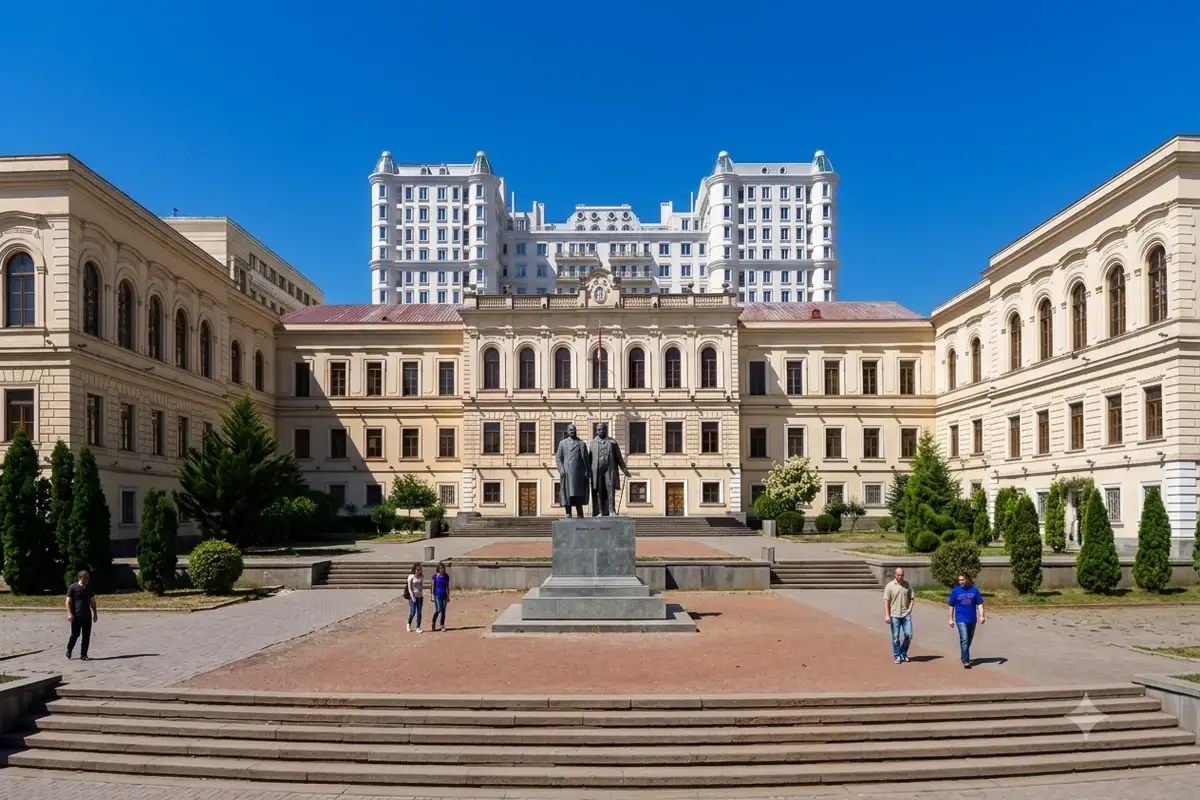
Tbilisi State Medical University (TSMU) is a flagship public medical institution and Georgia’s largest university for enrolled medical students, with 9,400 students in 2026. Located in the heart of Georgia’s capital city, Tbilisi, the university was founded in 1918 as the ‘Faculty of Medicine’ of Tbilisi State University, later became an independent institution in 1930, and received university status in 1992. It offers a 6-year MD degree programme (equivalent to an MBBS in India) to all international students who want to study medicine at TSMU Georgia.
As a public research university, it offers an extensive range of learning opportunities. Approximately 3,400 international students from 84 countries are pursuing their MBBS in Tbilisi State Medical University (TSMU). The standard English-language Medical Doctor (MD) programme accounts for 360 ECTS credits. TSMU has a network of five university clinics and works with more than 120 universities and university clinics in over 40 countries. With the recognised status of “Tbilisi State Medical University approved MCI”, Indian medical aspirants will be eligible to appear for the FMGE/NExT and register with the National Medical Commission (NMC).
At a glance
| Particulars | Details |
|---|---|
| University Name | Tbilisi State Medical University (TSMU) |
| Established | 1918 |
| Location | 33 Vazha Pshavela Ave, Tbilisi, Georgia |
| Course Offered | General Medicine (MD Degree Programme) |
| Course Duration | 6 Years (12 semesters; 5-year coursework + 1-year clinical internship) |
| Medium of Instruction | English for foreign students, but Georgian is taught for patient interactions |
| Recognition | Listed in WDOMS, recognised by WHO, NMC, FAIMER, ECFMG, accredited by the Georgian Ministry of Education |
| Eligibility | 10+2 with PCB, scored 50% (40% SC/ST/OBC), 17 years |
| Intake | September |
| Application Deadline | July |
| Tuition (Year 1) | ₹7,20,000 |
| Total Students | 9,400+ Students |
| Indian Students | 800+ Indian Students (unverified figure) |
| Countries Represented | 84 countries |
TSMU Georgia is accredited by the NCEQE and recognised by global medical bodies like ECFMG and WFME, and is listed in the WDOMS recognised by the WFME.
The MBBS in Tbilisi State Medical University is conducted entirely in English for all enrolled international students, with Georgian language training for the clinical phase.
Tbilisi State Medical University fees are $8,000 per year (₹7,20,000 per year in Indian currency at an exchange rate of $1 = ₹90).
The university operates a Clinical Skills and Multidisciplinary Simulation Centre, research institutes in medical biotechnology and pharmacochemistry, and laboratories, along with a sports centre and a library.
Approximately 3,400 international students from 84 countries pursue their MBBS in Georgia Tbilisi at TSMU, allowing Indian students to form a large student network.
Through 5 university clinics and affiliated healthcare networks, Tbilisi State Medical University offers medical students a practical learning environment, alongside OSCE-based skills assessment.
Recognition
Neither the National Medical Commission (NMC) nor the World Health Organization (WHO) publishes an “approved” list of foreign universities, which consultants and agents commonly use. In reality, the WHO previously managed the original directories of medical schools from 1953 to 2007 and passed them to the World Federation for Medical Education (WFME), which manages the World Directory of Medical Schools (WDOMS) in collaboration with the FAIMER; TSMU is listed in this directory. Additionally, the claim that Tbilisi State Medical University approved MCI is somewhat true, because it complies with the “NMC” guidelines; the National Medical Commission replaced MCI (Medical Council of India) on September 25, 2020.
FAIMER - Foundation for Advancement of International Education and Research
The NMC has outlined certain guidelines, termed FMGL Regulations, that all Indian citizens and Overseas Citizens of India must satisfy for a valid registration and medical practice in India. The table below lists all the major NMC requirements that Tbilisi State Medical University meets; however, you must obtain a written confirmation before paying the fees.
| NMC requirement | Status |
|---|---|
| Minimum 54 months of theoretical instruction | Compliant |
| 12-month clinical internship | Compliant |
| English as the medium of instruction | Compliant |
| All mandatory Schedule 1 subjects taught | Compliant |
| The degree awarded is a primary medical qualification | Compliant |
| Internship completed at the university-affiliated hospital | Compliant |
Always cross-check the current NMC and WDOMS listings before finalising any foreign medical university/institution. Ask us, and we will point you in the right direction.
Not sat it yet? Put in the score you expect — you can redo this later.
The PCB average, not your overall percentage.
Ranking
| Ranking body | World | Georgia | Regional |
|---|---|---|---|
| Times Higher Education (THE) | 1001-1500 (sustainability impact ratings 2026) | N/A | N/A |
| SCImago Institutions Rankings (by subject) | 5394 | 1 | 257 (Eastern Europe) |
| Webometrics | 4441 | 5 | 1276 (Asia) |
| EduRank | 3986 | 4 | 1314 (Asia) |
| UNIRANKS | 3697 | 4 | 1597 (Asia) |
Tbilisi State Medical University ranking is 5394th globally, 1st nationally, and 257th regionally (in Eastern Europe) by SCImago Institutions Rankings by Subject (in medicine). Times Higher Education (THE) ranked the university among the top 1001-1500 institutions in terms of sustainability impact for 2026. Look at the table below to see more detail:
Fees
Tbilisi State Medical University fees are $8,000 per year (₹7.20 lakh per year at an exchange rate of $1 = ₹90). The university fees and any deposits are made in US dollars (USD) and can change at any time at the university's discretion. The table below shows the complete Tbilisi State Medical University fee structure in USD and INR, based on an exchange rate of $1 = ₹90. TSMU charges $8,000 per year in tuition for international students; hostel charges cost about $3,000 for the 1st year, and medical insurance costs $100 for the 1st year, along with other expenses. These expenses are more affordable than private colleges in India, which often cost more than ₹1 crore. It should be noted that hostels are not provided by most Georgian universities, so students bear that cost. Always check with the counsellors if they’re providing any accommodation, even if they’re affiliated with the Tbilisi State Medical University.
| Item | Amount (approx.) |
|---|---|
| Tuition - Year 1 | USD 8,000 · ≈ ₹7,20,000 |
| Tuition - Years 2 to 6 (each) | USD 8,000 · ≈ ₹7,20,000 |
| Hostel + Food (Per Year) | USD 3,000 · ≈ ₹2,70,000 |
| Medical Insurance (Per Year) | USD 100 · ≈ ₹9,000 |
| Tuition Fee Across the Full Six Years | USD 48,000 · ≈ ₹43,20,000 |
| Overall 6-Year MBBS Budget | USD 76,600–77,933 · ≈ ₹68.94–70.14 lakh |
| Food (self-cook), Flights & Personal Spending (6 Years) | USD 11,600–12,933 · ≈ ₹10.44–11.64 lakh |
Note: The shown values are based on the university's prevailing tuition fees for international students and other estimated expenses. These are subject to change depending on different factors, including policy changes, inflation rates, and exchange rate fluctuations. The Indian values presented are based on an exchange rate of $1 = ₹90.
Total cost of the six-year programme: about ₹28.64 lakh, which changes according to the university’s and country’s regulations and other relevant factors. Food, flights and personal expenses add another significant category of overall expenditure in your 6-year journey, depending on the specific location where you live (both in India and abroad), lifestyle habits, and how much the university charges for miscellaneous expenses (laptop, textbooks, etc.).
Tuition fees are only part of the entire budget. Add other expenses to know the actual cost.
Tuition is only part of it. Add hostel, food and flights to see what six years actually costs you.
Total across six years
₹0
Want this as a one-page PDF you can show your family?
Get the fee sheetLiving costs
| Item | Amount (approx.) |
|---|---|
| Hostel Accommodation Per Year | USD 1,800 · ≈ ₹1,62,000 |
| Indian Tiffin Service Per Year | USD 1,200 · ≈ ₹1,08,000 |
| Self-catering (instead of a mess) Per Year | USD 600 · ≈ ₹54,000 |
| Local Transport Per Year | USD 500 · ≈ ₹45,000 |
| Admin, Medical, Visa & Biometrics (Single Time) | USD 2,600 · ≈ ₹2,34,000 |
Eligibility
Not sure whether your qualification meets the requirements? Send us your details, and we will tell you straight.
Admission
The enrolment is pretty straightforward for all Indian applicants, free of any additional donation or capitation charges. Here are the steps for the Tbilisi State Medical University admission:
Check TSMU Georgia eligibility: academic qualifications, language proficiency, and required documentation, along with any additional requirements.
Prepare all the required documentation in the required format (translation, notarisation). Submit the application to the university’s online admission portal.
Tbilisi State Medical University will review your application, and you might have to attend an online interview (if you have to submit proof of English language proficiency).
After reviewing your application, TSMU will provide you with an official admission letter. Obtain a letter of recognition from the NCEQE and submit it to the university.
Submit the ministry documents and receive the rector’s order from the Georgian ministry. Apply for a D3 student visa through the official Georgia e-Visa Portal.
Arrange accommodation and travel after getting the visa. Reach Tbilisi State Medical University for the final enrolment process, residence formalities, and orientation.
| Stage | When |
|---|---|
| Applications Open | June |
| Application Window | July |
| Application Deadline | August |
| Review and Interview | August |
| Invitation Letter and Visa | September |
| Classes Begin | October |
Paperwork
All documents must be translated into the requested language and notarised before submission.
Curriculum
| Stage | Phase | What you study |
|---|---|---|
| Years 1-2 | Preclinical | Anatomy, histology, physiology, biochemistry, genetics, cell biology, public health and communication |
| Year 3 | Para-clinical | Pathology, microbiology, pharmacology, diagnostics, ethics, clinical skills and early patient contact |
| Years 4-5 | Clinical | Internal medicine, surgery, paediatrics, obstetrics and gynaecology, psychiatry, neurology, emergency care and family medicine |
| Year 6 | Clinical Internship | Supervised clinical rotations across major departments at university clinics, hospitals or healthcare institutions |
Outcomes
| Year | Appeared | Passed | Pass rate |
|---|---|---|---|
| December 2025 | 340 | 86 | 25.29% |
| 2024 | 703 | 215 | 30.58% |
| 2023 | 624 | 130 | 20.83% |
| 2022 | 530 | 156 | 29.43% |
According to the FMGE performance report from the National Board of Examinations in Medical Sciences (NBEMS), here are the Tbilisi State Medical University FMGE passing rates: 530 appeared and 156 passed in 2022 (29.43%), 624 appeared and 130 passed in 2023 (20.83%), 703 appeared and 215 passed in 2024 (30.58%), and 638 appeared and 148 passed in December 2025 (23.20%). Since the full-year (2025) report is yet to be published by the NBEMS, the figure can’t be accurately compared with the previous years. While we can observe a downward trend from 2024 (full year) to 2025 (partial year), the lack of complete data does not reflect the reality of a candidate’s FMGE score and future outcomes. Cur
Curious about your FMGE outcome after graduation? Talk to us before you apply.
Talk to a counsellor about outcomesProgrammes
6 Years
A 6-year one-cycle MD (Medical Doctor) programme with 360 ECTS, integrating topics related to biology, behavioural, social, and clinical sciences, with practical training.
6 Years
An English-medium six-year programme in collaboration with Emory University, offering a fully integrated US-based curriculum; international tuition fees are higher than the standard MD programme.
5 Years
A 300-ECTS one-cycle programme comprising biomedical foundations, preventive medicine, dentistry, oral surgery, orthodontics, prosthodontics, and supervised dental practice.
4 Years
An English-language bachelor’s programme focused on assessment, therapeutic exercise, rehabilitation methods, patient communication and supervised practice.
An English-language bachelor’s programme covering pharmaceutical sciences, pharmacology, technology, quality assurance, and professional practice.
Tbilisi State Medical University also offers master’s, residency programmes (continuous professional development) and PhD pathways in medical and healthcare disciplines.
| Particulars | Details |
|---|---|
| Primary Course | Medical Doctor (English); equivalent to an MBBS in India |
| Duration | 6 Years (12 semesters; 5-year coursework + 1-year clinical internship) |
| Medium of Instruction | English for foreign students, but Georgian is taught for patient interactions |
| Intake | October |
| Application Deadline | Around July |
| Degree Awarded | MD; undergraduate degree |
Student life
The Tbilisi State Medical University hostel in development will offer different room options, including single, double, and shared formats with all the basic facilities.
Facilities include Wi-Fi, laundry, kitchens, reading halls, and recreational areas, designed to support both academic focus and social interaction among residents.
Security is ensured with 24/7 CCTV surveillance, employed wardens, and readily available medical assistance, alongside dedicated student support services to maintain a safe environment.
Sports & recreational facilities include gyms, stadiums, and cultural events, while encouraging students to balance their daily studies with fitness, arts, and extracurricular activities.
As of September 2026, the student dormitories are still in development, as shown on the official website of Tbilisi State Medical University, and will accommodate up to 800 people.
On food: Dining facilities at the future Tbilisi State Medical University hostel will provide affordable meals, with Georgian and international options. Students can access canteens, cafeterias, and kitchens to prepare meals to meet their dietary needs. Tbilisi State Medical University emphasises a healthy and balanced diet to fulfil basic nutritional requirements.
Rooms are allotted by the international office. Ask early if you have any preferences.
The city
TSMU Georgia address is 33 Vazha Pshavela Avenue in the capital city of Tbilisi, Georgia. Tbilisi is a major education, healthcare, transport and cultural centre, combining modern neighbourhoods with an historic old town.
Tbilisi uses Georgia Standard Time (UTC+4) throughout the year; India is 1 hour and 30 minutes ahead of Tbilisi.
Students can access metro, municipal buses and other public transport. A basic 90-minute public transport ticket costs GEL 1, and permit transfers are within the validity period.
Students are advised to practise basic safety procedures and keep their documentation ready for any urgent purposes. Avoid taking any dark alley roads or unlicensed taxis, and always share details with a trusted individual.
| Season | Typical range | What to expect |
|---|---|---|
| Summer (June - August) | 17°C to 32°C | Hot and mostly dry conditions; July and August are the warmest months |
| Autumn (September - November) | 4°C to 27°C | Warm and early months of autumn are followed by cooler & wetter conditions |
| Winter (December - February) | −1°C to 9°C | Cold weather with occasional snowfall. Keep the central heating system working. |
| Spring (March - May) | 4°C to 24°C | A rapidly warming season with variable weather conditions; the year's wettest time. |
After graduation
After completing the degree programme at Tbilisi State Medical University, one must meet the NMC’s latest FMGL Regulations and guidelines for medical aspirants. Graduates must appear for the FMGE (or NExT when officially implemented) and complete a year-long internship.
To practise medicine in Georgia, graduates must satisfy the local licensing requirements. International medical graduates (IMGs) must clear the National Post-Diploma Qualification Exam (NPDQE) after obtaining the primary medical qualification from the TSMU Georgia,
Graduates can also pursue international career pathways by choosing to either study or obtain a licence to practise in a particular country. Some popular choices include the USA’s USMLE, the UK’s PLAB, Australia’s AMC and other examinations.
Almost every Indian graduate takes the FMGE. Got other plans?
Discuss with an experienced counselorTravel
Students generally arrive at Shota Rustaveli Tbilisi International Airport (TBS), approximately 17 km southeast of central Tbilisi, and it is connected with the city through road, rail, and public transport.
Travellers from India can reach Tbilisi through direct or one-stop flights, depending on the departure city and airline schedules. Common routes include Mumbai/Hyderabad/Bengaluru to Tbilisi.
At the airport, complete the immigration and get in touch with our representative. They will escort you to the Tbilisi State Medical University for the final formalities in the enrolment process.
Next step
Send your NEET score and Class 12 marks, and we will confirm whether you meet the NMC eligibility rules before anything is submitted to the university.
FAQ
The NMC does not “approve” any foreign medical institution; rather, it verifies if a graduate and its degree-rewarding institution match its guidelines and establishes the FMGL Regulations 2021 for opening up the licensing route in India. Tbilisi State Medical University approved MCI is valid in that sense, since it complies with its guidelines and is enlisted in the WDOMS.
The overall duration of pursuing the English-medium Medical Doctor (equivalent to an MBBS in India) programme is 6 years with 360 ECTS credits at Tbilisi State Medical University, comprising 5 years of academics & clinical experience, followed by a mandatory 1-year clinical internship.
The Tbilisi State Medical University fee structure shows that the overall cost to study its English-taught medical programme for Indian students will range anywhere from $76,600 to $77,933, translating to ₹68.94 lakh - ₹70.14 lakh in Indian rupees at an exchange rate of $1 = ₹90. The actual cost of studying will depend on the exact programme, accommodation and other relevant variables involved in the 6-year duration.
Tbilisi State Medical University ranking is 5394th globally (SCImago Institutions Rankings by subject in medicine), among 1001-1500 top universities internationally for the sustainable impact ratings in 2026 (Times Higher Education), and 5th in Georgia (Webometrics). SCImago ranked it 1st in Georgia, while EduRank and UNIRANKS placed it in 4th position in Georgia, respectively.
Yes, it is applicable for Tbilisi State Medical University Indian students to study medicine due to its accreditation and recognition from the Georgian Ministry of Education, the National Center for Educational Quality Enhancement (NCEQE), and various other international medical bodies. The university is also listed in the World Directory of Medical Schools (WDOMS), and the standard English-medium MD programme is NMC-compliant.
Tbilisi State Medical University does not require a NEET-UG qualification for the admission to its English-medium medical programme. However, as per the NMC’s public notification released in 2020, all students planning to study MBBS abroad and seeking medical practice in India after graduation must clear the NEET-UG; the scorecard remains valid for up to three years from the date of the results.
The Tbilisi State Medical University hostel is under construction and will be able to accommodate up to 800 students. The hostel will provide students with all the facilities and amenities, including wi-fi, laundry facilities, kitchens, reading halls, and recreational facilities, with 3 different room types.
Yes, TSMU Georgia offers two different medical programmes for international students to study medicine in English: a standard English-medium MD programme and the US MD programme. Both the programmes deliver 100% English-taught coursework but have varying degrees of status with the NMC guidelines, since the US MD programme is in collaboration with Emory University, offering a US-based medical curriculum, leading to non-compliance with one of the NMC guidelines on studying mandatory subjects.
Yes, after completion of an MBBS in Georgia Tbilisi, students can practise medicine in India by qualifying for the FMGE/NExT, completing a CRMI (Compulsory Rotatory Medical Internship) at an NMC-recognised healthcare institution/facility, and obtaining a valid registration certificate from the NMC or a state-specific medical council.
Tbilisi State Medical University FMGE passing rate is 29.43% in 2022, 20.83% in 2023, 30.58% in 2024, and 23.20% in 2025 (only for the December session).